Birds #6 (2026)
Anxiety is often intertwined with birding, in various ways. Year to year, an overriding worry is whether the birds are as abundant as they were in years past. Friends on social media often ask, sometimes to me directly, whether I’ve seen a particular species yet this year, or whether the woods and fields seem quieter than in years past. My grandmother, in the last years of her life, was convinced that the woods were quieter, that there were fewer birds calling in the woods surrounding the southwest New Hampshire home where she lived for nearly 50 years.
I’m never sure, year to year. As with trying to directly link a specific natural disaster to climate change, it seems like a tricky business to measure my anecdotal springs against the (real) phenomenon of bird population decline. Are populations decreasing overall? Certainly. Is that trend reflected in my woods in 2026? I can’t say. Of course I worry, though.
But this year, for whatever reason, I’m struck by abundance. By how many of my days are filled with the songs of scarlet tanagers and wood thrushes and indigo buntings and purple finches. Many more, it seems, than in years past. But this could be misremembering, and much of it could be due to chance. Maybe more tent caterpillars in our trees are attracting more tanagers, for example. Whatever the reasons, I’m grateful. Spring isn’t silent yet.
Yesterday was a great day, birdwise. Our cat woke me up wanting breakfast at 5:45 a.m., and rather than go back to bed after putting some kibble in his bowl (which he didn’t deign to eat until 6:30), I decided to make coffee and try to go birding earlier than usual. I was in the Windsor Grasslands by 7:15, and I was the only one there. Immediately, feet from the parking area, I saw the necks and heads of two female turkeys bobbing above the tall grass, as well as two Canada geese keeping a close watch on them. But as I started down the familiar trail and heard all the familiar songs, a different kind of birding anxiety took me: should I go somewhere else, somewhere I might be more likely to see birds I haven’t yet this year? What am I missing? But if I left to drive another 30 minutes, would I be losing out on the early morning rush of activity?
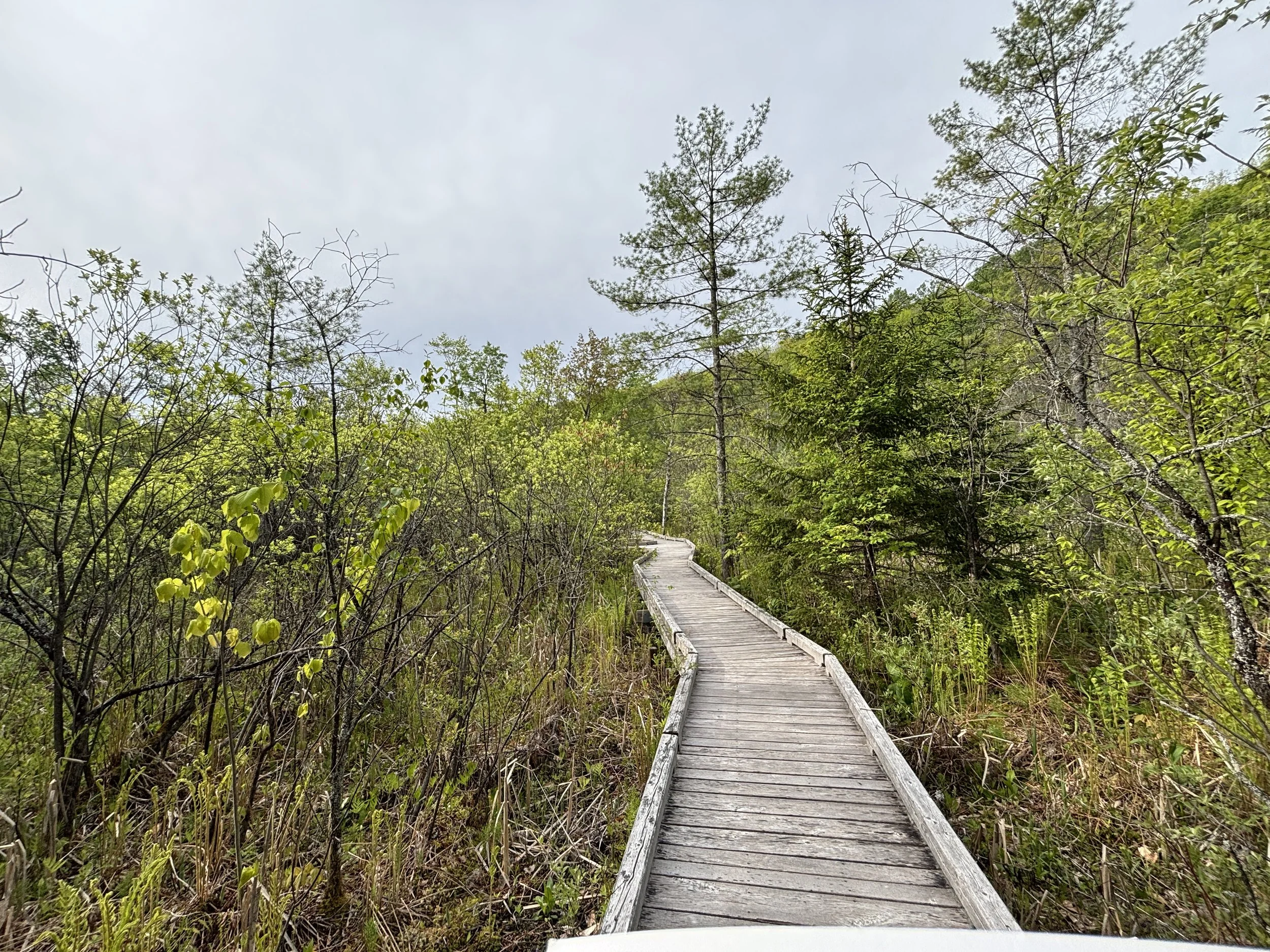
I weighed all of these questions against the calendar of the year, with fewer and fewer remaining chances to bird during spring migration, and decided to go for it, heading up to Eshqua Bog on the upland border of Woodstock and Hartland. Again, at Eshqua, I was alone, at least to start. And for a while I didn’t hear or see anything I haven’t elsewhere this year. But it was good to be among tamarack trees and yellow lady-slippers and (new to me) creeping foam flower and a few lingering painted trilliums. Ultimately I counted nearly thirty species, including winter wren and eastern wood-pewee, which were firsts-of-the-year for me. I also had a good long look at an ovenbird hopping along a fallen tree. I’ve only seen and not heard ovenbirds a handful of times, once also memorably at Eshqua Bog.
Eshqua Bog: common yellowthroat, ovenbird, chestnut-sided warbler, American redstart, northern yellow warbler, yellow-rumped warbler, black-and-white warbler, northern parula, yellow-bellied sapsucker, hairy woodpecker, brown creeper, red-eyed vireo, blue-headed vireo, tufted titmouse, black-capped chickadee, white-breasted nuthatch, blue jay, hermit thrush, veery, American robin, eastern wood-pewee, least flycatcher, eastern phoebe, winter wren, scarlet tanager, gray catbird, American crow, common raven, American goldfinch
While making my usual figure-8 around the perimeter and over the boardwalk, I heard a few car doors toward the entrance, and eventually passed a trio that appeared to be grandparents and grandson. Their license plate was from Kentucky. Not long after, I heard a different child shouting and complaining about being bored, and not wanting to be at the Bog. As they got nearer, his father patiently and bemusedly agreed that “Yes, I love stupid birds and stupid flowers” and explained that he just wanted to see some lady slippers and a few other things and then they could leave. The kid did not seem irate, but he was definitely bored and loud and loudly bored, wanting to be anywhere but in the middle of nowhere. Their license plate was from Massachusetts.
I got back into my car and decided to visit the Grasslands again on my way home. Along the way, near the Bog, I coveted the cabins and houses and farms in this remote stretch of Vermont, as I always do, tucked away in tiny valleys and glens.
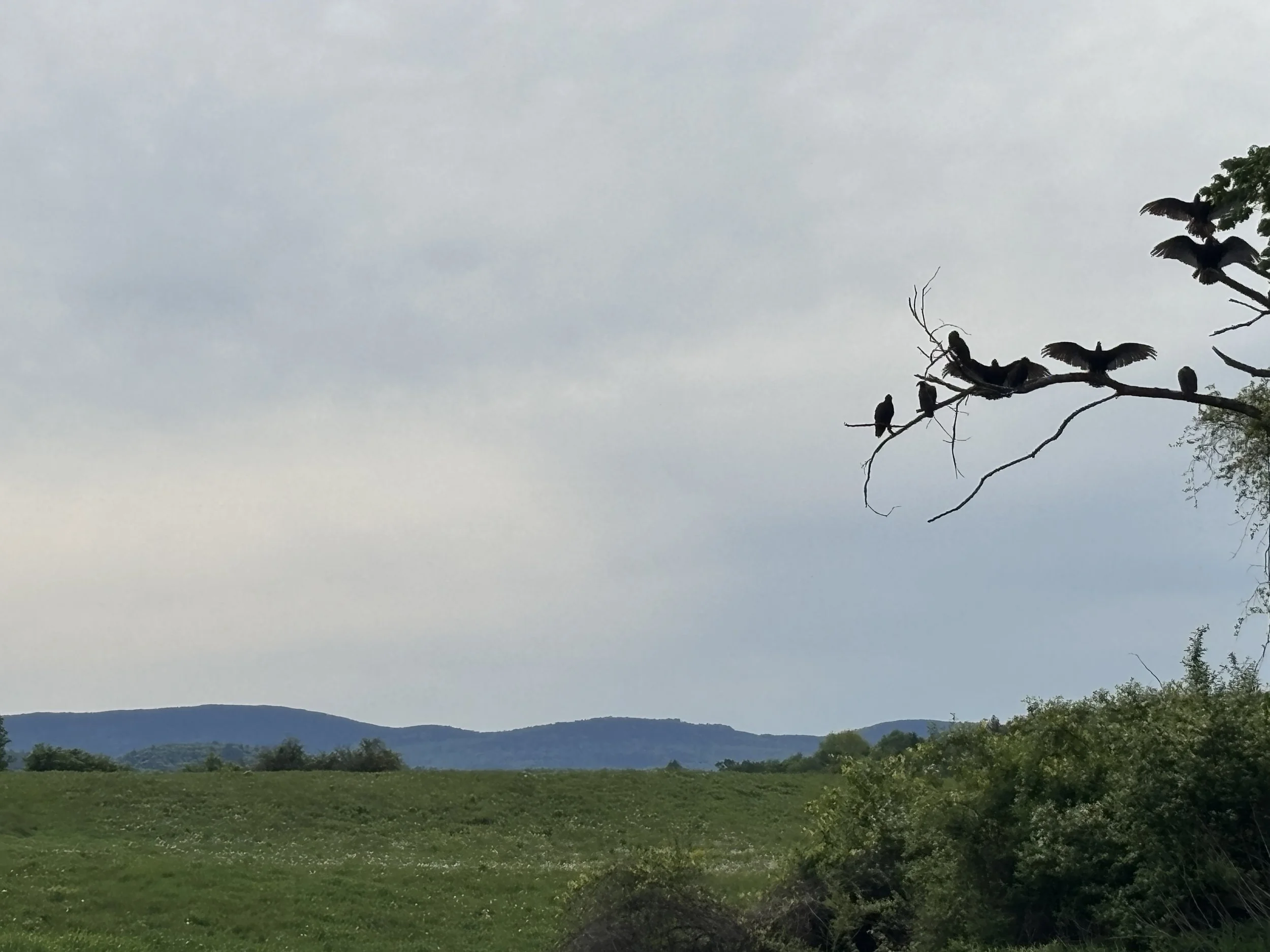
I parked at the orchard-side “lot” at the Grasslands, where a woman clearly there to bird with her large binoculars and outdoor gear was talking with a woman about to leave after walking her dog. I asked the birder if she’d heard the black-billed cuckoo yet and she hadn’t; she’d just arrived. I headed up the gravel path between the wide open grasslands and the abandoned orchard, hearing the usual suspects of eastern towhee, field sparrow, and bobolink. As I got nearer to a stand of trees that rises from the grassland, I saw that one dead tree held on one its branches no fewer than 14 turkey vultures, resting and occasionally airing out their massive wings. I padded closer as quietly as I could to take photos. Behind me, I could see the woman slowly progressing as she peered through her binoculars into the scrub. Eventually, as I saw her walking again in my direction I pointed to the vulture tree and she nodded that she’d seen it.
When she caught up with me we marveled at it for a few minutes. She explained that she was a Minnesota native now visiting from California. She was an experienced and enthusiastic birder, but had little experience with New England birds, and was thrilled even to see an eastern blue jay. She was hoping to see bobolinks and warblers. As we walked and talked, we heard the black-billed cuckoo far off in the distance, heard a towhee scratching around in the leaf litter, and saw a couple flycatchers as well. I pointed out the buzzy song of the blue-winged warbler, and eventually I headed back to my car as she went off to try and spot it. Nearer to the road I saw a young 20-something guy with binoculars holding out his phone, likely activating the Merlin app. As I approached he asked me if this was a place he could see a chestnut-sided warbler. They’d been singing a lot, all over the place, so I said yes and then we paused to listen. The guy was from Massachusetts, in the area to camp with his girlfriend, who was sleeping in. He had a list of birds he’d never seen and wanted to, and at the top was the chestnut-sided warbler. When one started singing close by I pointed it out and then we walked a few yards until I spotted it. No sooner did I point in its direction than the warbler flew directly toward us, zooming past our faces and landing just a few feet away in a sapling, at eye level. We didn’t need binoculars to clearly see its yellow cap, black stripes, and brown sides. We were both amazed, and he was not only able to strike it from his list, but to have a memorable encounter with the bird.
Then an older man approached, decked out in camo and carrying a massive camera. He was particularly fond of blue-winged warblers, and he showed us a few of the snaps he had just taken on the other side of the Grasslands. I left them and drove home, where before I’d left at 7 in the morning I’d heard a magnolia warbler singing by the driveway. All yesterday afternoon and evening I sat outside listening to birds, and feeling very fortunate.
Grasslands: black-throated green warbler, northern yellow warbler, Blackburnian warbler, chestnut-sided warbler, ovenbird, common yellowthroat, blue-winged warbler, American redstart, eastern phoebe, alder flycatcher, least flycatcher, eastern kingbird, American robin, veery, tree swallow, northern house wren, pileated woodpecker, yellow-bellied sapsucker, hairy woodpecker, red-eyed vireo, turkey vulture, Canada goose, American crow, wild turkey, black-billed cuckoo, gray catbird, swamp sparrow, field sparrow, song sparrow, white-throated sparrow, eastern towhee, American goldfinch, house finch, indigo bunting, bobolink, Baltimore oriole, tufted titmouse, black-capped chickadee, blue jay, northern cardinal, mourning dove, pine siskin (maybe)
Home: magnolia warbler, scarlet tanager, indigo bunting, Blackburnian warbler, black-and-white warbler, chestnut-sided warbler, American redstart, rose-breasted grosbeak, wood thrush, veery, purple finch, northern cardinal, ovenbird, song sparrow, eastern phoebe
Last night I also pulled out my copy of Edwin Teale’s North with the Spring which I’ve owned for years along with the other season books (I recently finally got a hold of a used copy of Winter). More on this later.